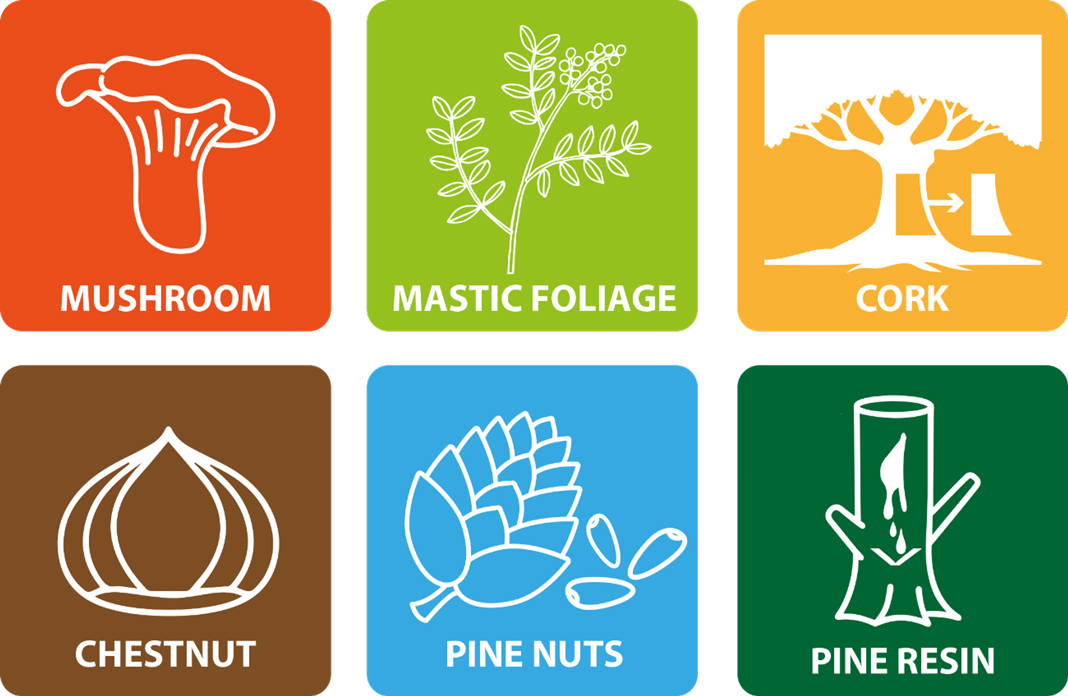
Non-wood forest products (NWFPs), such as mushrooms, cork, resin, pine nuts, chestnuts, and mastic, are a vital yet often overlooked part of rural economies in Spain. While these products generate income and support livelihoods, surprisingly little is known about the people who collect them.
The IMFOREST study, led by CTFC in collaboration with COSE, CSIC-INIA, and Cesefor, sheds light on the profiles, challenges, and opportunities of commercial harvesters across the country, based on interviews with both harvesters and their employers.
A flexible, often invisible workforce
Most NWFP harvesters operate as self-employed individuals or small-scale entrepreneurs. Only a small proportion — mainly in resin tapping — work full time in a single activity. For the majority, harvesting is seasonal or provides complementary income alongside forestry or entirely different occupations.
Because of this informal and seasonal nature, these workers often remain invisible in official statistics, making it difficult to fully understand the sector or design effective public policies.
Social networks play a key role in shaping access. Many harvesters enter the sector through family ties or local contacts rather than formal training or recruitment pathways. This reliance on existing networks can limit opportunities for newcomers and reinforce participation patterns within the sector.
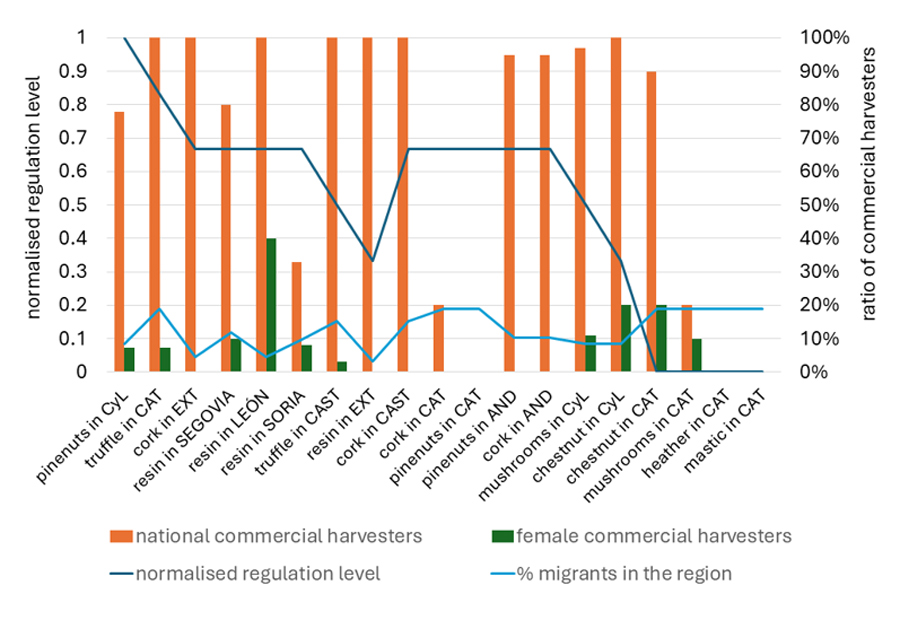
The sector is largely male-dominated, reflecting long-standing cultural norms around forestry work. Women are present, but primarily in activities such as mushroom, chestnut, and resin collection — roles that can be more flexible and easier to self-organise, supporting work–life balance. These patterns are influenced not only by physical demands but also by cultural perceptions of forestry work as traditionally male, which may discourage broader female participation.
Migrant workers also play an important role. Their presence tends to reflect local demographics, with higher participation in regions where migrant populations are larger. Less regulated or more informal activities can offer easier entry points, particularly where alternative employment opportunities are limited.
Access, skills, and investment
Access to land is a crucial factor. In Spain, forest products belong to landowners, meaning harvesters must obtain permission to collect them. For those who do not own land, this requires negotiation skills, administrative capacity, or strong local connections. In this context, access to natural capital — understood as the right to harvest resources — becomes a key determinant of success.
Skill requirements vary considerably across activities. Some, such as mushroom or chestnut picking, require relatively basic knowledge. Others, including cork extraction and resin tapping, demand specialised expertise and precision to avoid damaging trees. In these more technical sectors, training and experience (or human capital) are essential and can limit entry for newcomers.
Certain activities also require specific tools or machinery, representing an upfront investment. This “built capital” can be a significant barrier, especially for individuals with limited financial resources.
Why this matters
Non-wood forest products are increasingly important in Europe’s transition towards a bioeconomy, offering natural alternatives to synthetic materials while supporting rural employment.
However, without a clear understanding of the workforce behind these activities, it remains difficult to:
- attract new workers,
- ensure fair working conditions,
- manage conflicts with landowners, and
- promote sustainable harvesting practices.
Full reference
Górriz-Mifsud, E., Rovellada Ballesteros, M., Fernández, E., Miravet, A., Ojalvo, L., Quiroga, R., Rodríguez-García, A., & Sánchez-González, M. (2026). Commercial harvesters of non-wood forest products in Spain: An exploratory profiling. Forests, 17(5), 587.